
How Do Ports and Comps Actually Work?
Posted by Blackstone Shooting Sports on Jul 29th 2026
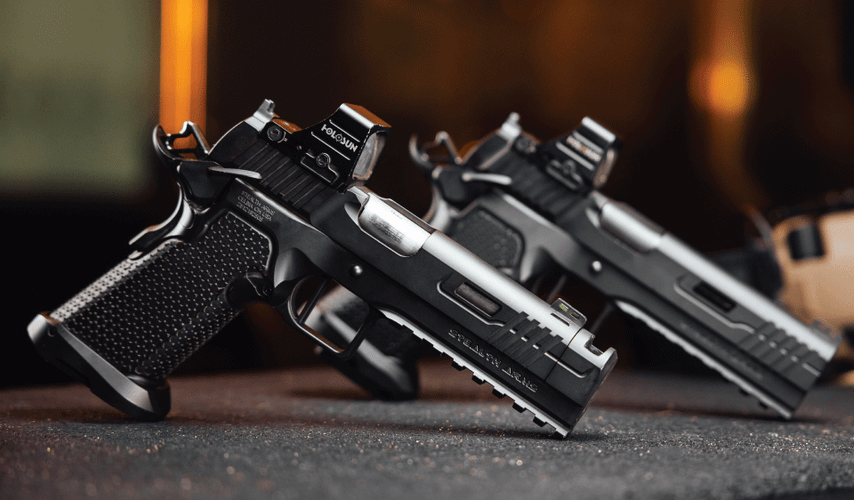
Compensated carry guns went from gunsmith projects to factory options almost overnight — Ramjets, Prime Radians, X Comps, comped 2011s. And with the trend came a lot of hand-wavy explanations of how they work. Most of them are close enough to sound right and wrong enough to matter. So here's the accurate version, in plain English.
FIRST, SEPARATE TWO DIFFERENT PROBLEMS
When a pistol fires, two things happen to it, and they are not the same thing. RECOIL is the gun driving straight back into your hand — equal and opposite reaction to launching the bullet and the gas forward. MUZZLE RISE (or muzzle flip) is the barrel pivoting upward — it happens because the bore sits above your grip, so the rearward push acts on a lever and rotates the gun in your hand.
Ports and comps mostly attack the second problem. That distinction matters, because it's the honest answer to what a comp does: it doesn't make the gun push back much less — it makes the gun stay FLAT. And flat is what you actually feel, and what your red dot cares about.
WHAT'S ACTUALLY HAPPENING INSIDE A COMP
A compensator is a chamber (or several) hanging past the muzzle, with an exit hole for the bullet and vent ports — usually cut into the top. When you fire, the bullet leaves the barrel followed by a slug of very high-pressure gas moving faster than the bullet itself. Instead of dumping straight forward like it would from a bare muzzle, that gas expands into the comp chamber, and two useful things happen almost simultaneously:
Force #1 — The gas pushes the gun forward
Expanding gas slams into the front internal walls of the comp — the baffle faces — and pushes on them. Those walls are attached to your gun, so the gas is literally shoving the pistol forward, directly against the recoil impulse driving it backward. This is the part most explanations get wrong or skip entirely: the gas doesn't get 'redirected backward' — it strikes forward-facing surfaces, and Newton's third law does the rest.
Force #2 — The upward vents push the muzzle down
The gas then escapes through the ports cut into the top of the comp. Venting gas UP creates an equal and opposite push DOWN on the muzzle — a small rocket thruster firing skyward, nailing the barrel down against the flip. This is the force that keeps the dot in the window.
Add them up: forward push fighting recoil, downward push fighting rise. The result you can see on a high-speed camera is a gun that tracks flatter and returns to target faster — which is the entire point. Your dot barely leaves the target, and your follow-up shot is waiting for you instead of somewhere above the berm.
PORTING — SAME PHYSICS, DIFFERENT ADDRESS
A ported barrel skips the hanging chamber and cuts the vents directly into the barrel itself (with matching cuts in the slide), just behind the muzzle. Gas starts venting upward WHILE the bullet is still passing — same downward reaction, same flip reduction, no added length. Factory 'comp' guns in the compact world are often actually ported or hybrid designs, because porting keeps the package holster-sized.
The honest cost of porting specifically: those vents open before the bullet exits, so some of the gas that was still accelerating the bullet leaves early. You give up some velocity — typically a modest amount, but it's real, and it's why the same ammo chronographs slower from a ported barrel than an unported one of equal length. A traditional muzzle comp costs little to no velocity, because it does its work after the bullet has left the barrel.
WHY YOUR AMMO CHOICE SUDDENLY MATTERS
Comps and ports run on gas — volume and pressure. More gas working the chambers and vents means more compensation. That's why comped guns are commonly tuned around specific loads, and why several factory comp pistols recommend stouter ammunition: a hotter load isn't just faster, it feeds the comp. Run a soft, low-pressure practice load through a comped gun and the comp does noticeably less — the gun still works, it just doesn't shoot as flat as designed. Check what your specific pistol is optimized for, and function-test the load you actually intend to carry. Every comped gun has preferences, and the range is where you find them.
THE HONEST TRADEOFFS
|
WHAT YOU'RE ACCEPTING IN EXCHANGE FOR FLAT • More blast and noise at the shooter and to the sides — the gas that used to leave forward is now venting up near your face. Doubling up on ear pro indoors goes from smart to strongly advised. • More visible flash from top vents in low light — worth knowing on a defensive gun; flash signature varies a lot by design and load. • Ported barrels give up some velocity; muzzle comps mostly don't — know which design your gun actually uses. • Vents collect carbon and need cleaning attention, and comped guns can be pickier about weak ammo cycling reliably. • Retention and close-quarters positions put those top vents closer to you — a training consideration, not a dealbreaker, but train informed. |
SO… DO THEY ACTUALLY WORK?
Yes — measurably. A well-designed comp or port system visibly reduces muzzle rise, keeps the dot in the window, and speeds real-world split times, and the effect scales with how much gas your ammo brings to the party. What they are not is free: you trade blast, some maintenance, ammo sensitivity, and — with porting — a little velocity. Whether that trade wins for YOU depends on the job: for a range gun or competition rig, it's an easy yes for most shooters. For a carry gun, it's a genuine judgment call — which is exactly the kind of call that's easier to make with the gun in your hands and a lane in front of you.
|
FEEL THE DIFFERENCE YOURSELF — AT BLACKSTONE • Comped and ported pistols are in the case — Ramjet-style builds, factory comp guns, and comped 2011s side by side with their standard siblings • Rent both versions and shoot them back to back on our range — flat is a feeling, and ten minutes on a lane answers this better than any article • We'll match ammo to your comp and talk through the carry question honestly at the counter • 2001 Wilkinson Blvd, Charlotte · (704) 414-6020 |